A wholesaler receives two offers: an African-market panga vs Latin-Style Machete. Both are long farm blades, but the labels do not settle the purchase.
A broad style description suggests a starting point. The actual products can differ in blade outline, swing feel, handle, finishing, and local acceptance.
Before comparing unit prices, put both finished tools against the same buyer requirement. This guide shows which differences deserve a closer look.
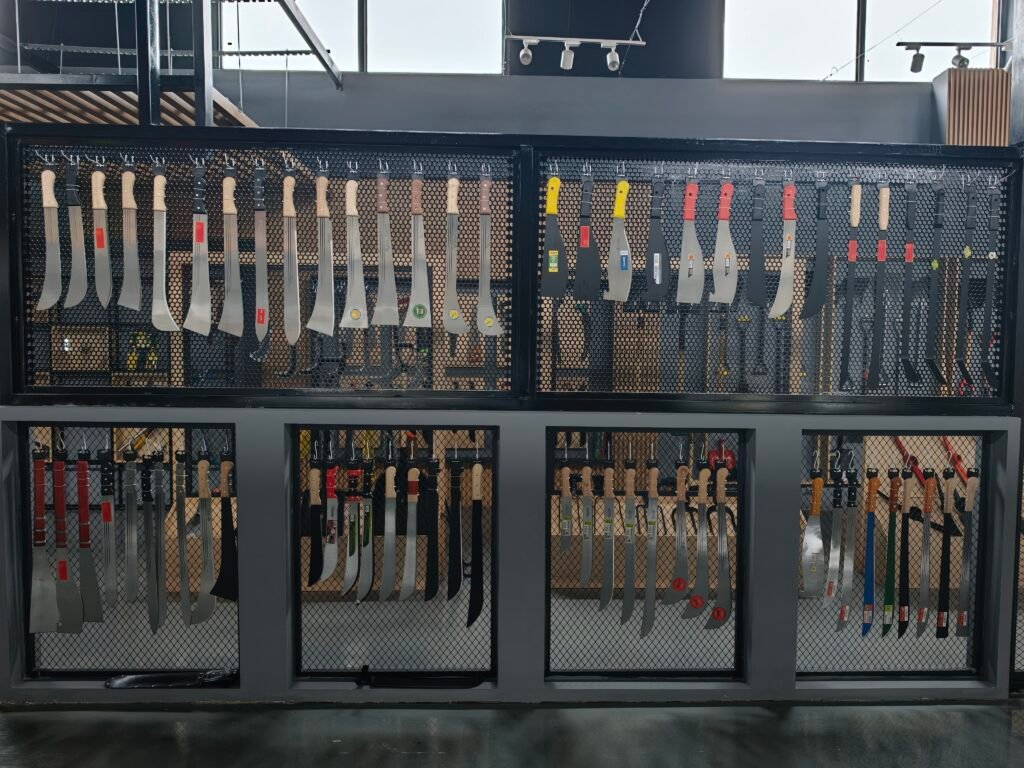
Compare the Actual Blade Profiles
A Latin-style, or bush-style, machete commonly has a fairly straight back and a relatively consistent working width. Catalogs often position it as an all-purpose clearing tool.
A panga is a regional name with several commercial interpretations. Some catalog examples have a deeper belly and an upturned tip.
Neither description is a universal production standard. A seller may call a blade a panga even when its outline differs from another supplier’s panga.
Obtain a full-length, flat photograph of each tool. Include a ruler and take a second photograph from the side.
Compare width at the handle end, middle, and forward end. Record where the blade becomes broader, not merely its maximum width.
Trace the tip. A rounded, raised, or more pointed end changes appearance and can affect how a worker controls the stroke.
Then check the edge line and spine separately. Two blades with similar front silhouettes may have different sharpened sections.
Do not infer thickness from photographs. Ask for measurements at agreed positions along the blade.
If a local sample exists, place its outline beside both quotations at the same scale. The reference matters more than a generic style diagram.
Request a Wholesale Quote:Whatsapp : (+86 13383021196) E-mail : gemlight@ganzhedao.com
Evaluate Balance Against the Work
Ask what the end user cuts most often. Light, flexible growth and more resistant brush can reward different handling preferences.
A longer, straighter blade may give useful reach during repeated clearing. A broader forward section may feel stronger during chopping.
Those are tendencies, not a promise that one named style outperforms the other. Weight, steel, edge geometry, and user technique also matter.
Record blade length and overall length separately. Some catalog sizes describe the blade; others may use another measurement convention.
Weigh the complete tools, including handles. Two blades of similar size can differ noticeably once assembled.
Have users hold and swing the samples safely before making a stock decision. Ask whether the weight feels concentrated toward the tip.
If a field trial is possible, compare both models on the same vegetation. Note control, fatigue, and sharpening needs, not just initial cutting speed.
A tool that impresses in one heavy cut may be less welcome during a full day of lighter clearing.
For a contract tied to a local pattern, do not substitute a Latin-style blade because its nominal length matches a panga.
Request a Wholesale Quote:Whatsapp : (+86 13383021196) E-mail : gemlight@ganzhedao.com
Check the Handle and Price Scope
Blade profiles attract attention, but workers grip the handle on every stroke. Compare its length, shape, material, and surface finish.
Inspect the handle attachment. Fasteners and fit should be checked on completed samples, not inferred from catalog pictures.
Ask what condition the cutting edge arrives in. A factory bevel may still require finishing before field use.
Confirm whether the quote includes edge protection, a sheath, marking, and retail packaging. These items can change a wholesale comparison.
Request the stated steel grade and, where relevant, verifiable test information. Vague words such as “premium” cannot substitute for a specification.
If hardness is required, define the test method, location, and acceptable range with your buyer. Do not copy an arbitrary number from an advertisement.
Calculate the price per equivalent finished unit. Comparing a protected, sharpened tool against an unfinished bare blade can mislead a distributor.
Ask whether a supplier proposes any change to the submitted outline. Put every exception on a separate quotation line.
Small handle or tip changes may seem harmless to a factory but matter greatly to repeat customers who expect the previous model.
Choose What Your Market Will Actually Accept
Speak with local wholesalers and the people using the blades. Their terms reveal what they request; samples reveal what they mean.
If customers ask for pangas, do not assume they will accept every product in an international panga category.
If they already buy a Latin-style blade under a local name, preserve the trusted shape and use a clear model code.
Request a small sample set before a large order. Let users compare the candidates with a locally successful tool.
Give each model a separate trial label that users cannot confuse. Write down which blade was used on which vegetation and for how long.
Compare repeated clearing strokes and controlled cuts separately. A forward-heavy option may win one test while the straighter option suits another.
Ask retailers whether buyers return for the same profile when their old tool wears out. Familiarity can matter more than a category’s popularity online.
If orders cover several towns, check whether one region’s preferred panga is recognized elsewhere. Do not generalize a single shop’s feedback.
When two models sell, keep their cartons and model numbers distinct. Shared packaging can conceal a substitution when stock is replenished.
Write down concrete feedback: handle too short, blade too wide near the tip, or weight tiring after repeated swings.
Use those observations to approve one model or maintain two distinct stock lines. Do not create two labels for the same blade without a real difference.
For a tender, the issued dimensions and sample approval process control the bid. Local preferences cannot replace mandatory written requirements.
Agree on tolerances, inspection points, and approval of production samples. A promising prototype does not guarantee consistent bulk delivery.
Keep the approved drawing, sample code, and packaging details together in the purchase order.
The practical comparison is not “Which name is better?” It is “Which finished model matches the work and existing market expectation?”
Send your local reference panga or Latin-style machete, intended task, and desired quantity with an inquiry. We can discuss matching samples and any differences openly.
Request a Wholesale Quote:Whatsapp : (+86 13383021196) E-mail : gemlight@ganzhedao.com