Quick Answer
A general-purpose cutlass may be preferable when crews spend most of their time on mixed maintenance and a tested cutlass handles their routine work. A cane knife deserves its own trial when repeated cane cutting and stalk handling dominate. Compare finished samples in each job, check tender rules, and specify separate models if one tool cannot serve both tasks well.
Key Takeaways
- “Cutlass” and “cane knife” do not each define one fixed blade geometry.
- Not every cane knife has a hook, and not every crew needs one.
- A local trial cannot prove long-term service life or guaranteed labor savings.
Identify the Dominant Job Before Choosing
Separate grass, brush, vines and cane stalks in the daily workload. If crews repeatedly move between path clearing and mixed vegetation, a locally accepted cutlass may reduce the need to carry another blade—provided it handles the demanding routine cuts.
If manual cane harvesting takes most of the shift, compare a specialized cane knife directly. Ask whether workers also move cut stalks and whether a hook helps; some crews use different equipment for that step.
Count task frequency rather than simply listing jobs. Where mechanized harvesting handles most cane, maintenance may dominate remaining manual work. Carrying a second blade, access between plots and shared-tool availability also affect the practical choice.
A tender may prescribe a specific design or equivalence process. A worker’s favorite sample cannot replace a noncompliant bid. Keep familiar local names, but specify and approve the actual geometry.
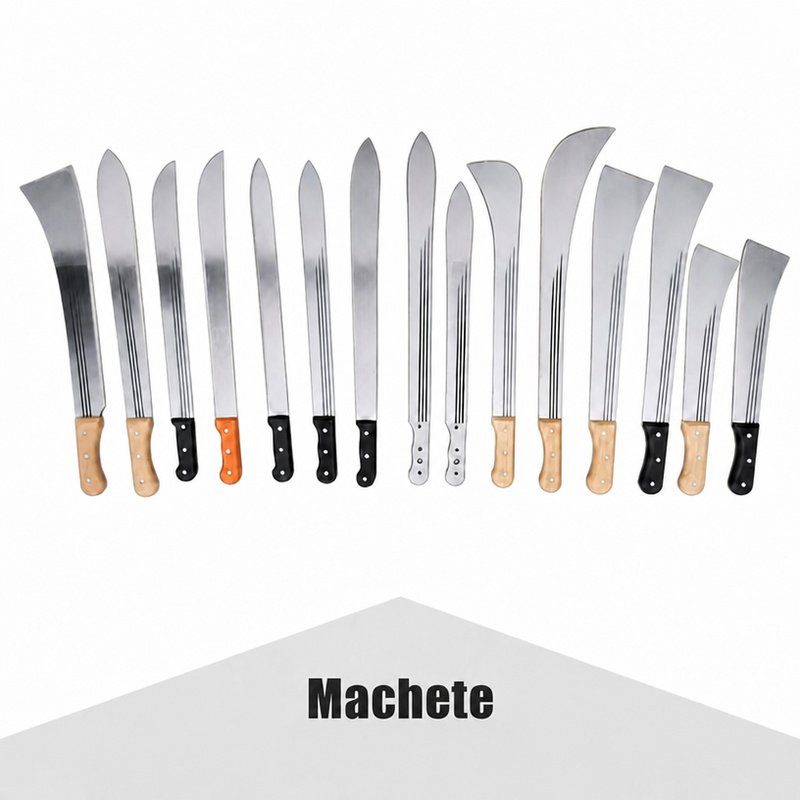
A machete style guide illustrates overlapping regional labels; its categories are context, not specifications for a particular supplier’s unit.
Request a Wholesale Quote:Whatsapp : (+86 13383021196) E-mail : gemlight@ganzhedao.com
Compare Complete Blades, Not Category Labels
Put the current farm blade beside proposed cutlass and cane-knife samples. Photograph each full outline with a ruler and record blade and overall lengths, width at agreed points, tip shape, assembled weight and handle construction.
Compare balance and control with the intended users. Check whether the delivered edge needs final sharpening and inspect the blade-to-handle joint. If a cane model includes a hook, document its size, sharpened area and matching guard.
Request a declared material and finish only where relevant to the RFQ. Do not infer steel grade or hardness from either name. Confirm wrapping, carton configuration and labels for the exact completed profile.
| Known about the job | What to verify | Purchasing action |
|---|---|---|
| Mixed vegetation and path work dominates | Whether the completed cutlass controls the hardest routine task | Trial the local cutlass against the proposed sample. |
| Manual cane cutting dominates | Repeated-cut comfort and whether stalk handling needs a hook | Trial the finished cane knife against the local reference. |
| Crews perform both jobs | Which model users choose for each job and whether carrying both is practical | Consider two coded SKUs if one sample is a poor compromise. |
| Tender or packing requirements apply | Required profile, equivalence evidence, guard and carton configuration | Exclude noncompliant offers and itemize delivered options. |
Trial Mixed Work and Cane Harvest Separately
Use a locally accepted reference, one proposed cutlass and one proposed cane knife in their quoted finished condition. Record edge preparation; a sharp new blade should not gain an unexamined advantage over a dull control.
Have experienced workers compare reach, control near crops and comfort in repeated maintenance cuts. Then test cane cutting only where manual harvesting is part of the actual workload, noting whether the tip or hook helps or hinders handling.
Ask which tool workers prefer for each task after more than one work period when practical. Note transport and stock-sharing problems as well as cuts. Record impacts with buried wire or stone separately from normal edge wear.
Where no single blade handles both stages well, split the order. A local trial can identify an obvious mismatch, but it cannot establish service life or a numerical productivity improvement for the whole market.
Request a Wholesale Quote:Whatsapp : (+86 13383021196) E-mail : gemlight@ganzhedao.com
Make the Purchase Decision Repeatable
Describe the accepted cutlass or cane knife with a model code, drawing and finished reference sample. If both are selected, keep separate inspection sheets, carton labels and intended-use descriptions.
RFQ checklist:
- Task mix and tender conditions: identify the dominant job and any compulsory design or equivalence rule before requesting a substitute.
- Separate model codes and measured profiles: keep two patterns distinct so a familiar category name cannot mask a swap.
- Handle, balance and delivered edge: specify the completed tool and sharpening state users accepted so quotes are comparable.
- Hook, guard and finish where applicable: define optional features and their coverage so price and safe packing refer to the same design.
- Approved sample and drawing revision: provide a retained reference so early production units and reorders can be checked consistently.
- Packing, inspection documents and deviations: itemize inclusions and require approval of alternate profiles before production.
Request comparable finished samples for both job types before confirming the model mix.
Review first-order feedback by task. Do not mix path-clearing complaints with cane-harvest observations when planning the next order.
Buyer FAQ
When does a cutlass make more sense than a cane knife?
When the tested cutlass suits the crew’s recurring mixed work and specialized cane harvesting is not the dominant manual job.
Does a cane knife always need a hook?
No. Ask who gathers cut stalks and whether the crew actually uses that feature. Approve the exact tip supplied.
Can one blade cover both jobs?
Possibly, but test both tasks. If it compromises either routine job, use two distinct models with clear intended uses.
Can a preferred local tool replace a tender-specified model?
Only if the tender allows an equivalent and the offer supplies the required evidence. A favorable trial alone is not compliance.
Request a Wholesale Quote:Whatsapp : (+86 13383021196) E-mail : gemlight@ganzhedao.com