Quick Answer
A wholesale machete specification should identify blade and overall length separately, define each measurement’s endpoints, and show width, thickness, tip shape, and sharpened-edge limits on a dimensioned profile. Add an approved finished sample, units, tolerances, and inspection points. These controls distinguish the accepted tool from another blade carrying the same nominal size.
Key Takeaways
- Nominal blade length does not establish overall or sharpened-edge length.
- Maximum width alone cannot preserve the location of a blade’s belly.
- Finished weight and handle construction need separate checks; neither is a blade dimension.
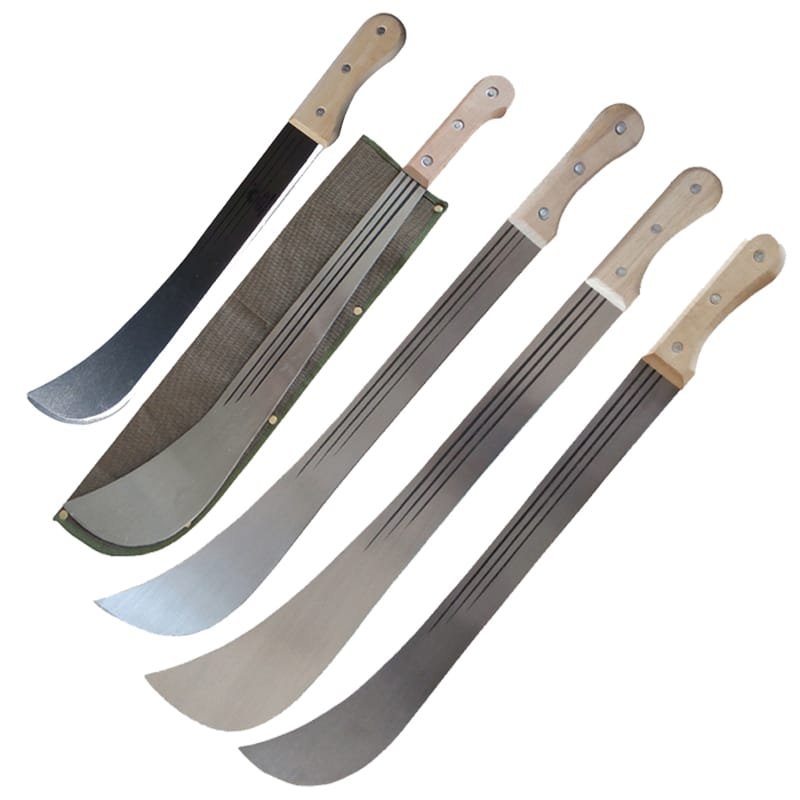
Which Lengths Need Separate Definitions?
State blade length and overall length on the finished machete. Mark the blade-to-handle transition, outermost tip and handle end as applicable to the agreed measurement method.
For a curve or hook, agree whether a straight reference line, centerline or another path governs the blade figure. Identify hook projection and the main cutting section separately.
Mark where sharpening begins and ends. Do not calculate usable cutting length by subtracting a handle dimension from a headline blade size.
Use one stated unit system on the controlling drawing. If a catalog quotes inches and production uses millimeters, reconcile the dimensions before sample approval.
Request a Wholesale Quote:Whatsapp : (+86 13383021196) E-mail : gemlight@ganzhedao.com
How Should Width, Thickness and Tip Be Recorded?
Record width near the handle, mid-blade and at the broadest working section. Show where maximum width occurs, not just the number.
Trace the belly, spine and tip on a dimensioned profile; use reference lines and offsets for critical curves. Measure thickness at agreed stock or spine points, noting taper and any coating convention.
Specify the accepted tip—rounded, squared, upturned or hooked—on the drawing. For hooks, define projection, opening, orientation and edge finish separately.
| Feature | Measurement to agree | Buyer action |
|---|---|---|
| Blade and total length | Start/end points, path, units and tolerances | Mark both on the approved drawing and finished sample. |
| Working edge | Sharpened start/end and delivered edge condition | Specify first-use sharpening separately from nominal size. |
| Width and outline | Widths at named stations; maximum and its location | Attach a dimensioned full-size profile where needed. |
| Thickness and tip | Stock locations, taper, hook geometry if present | Agree method and inspect several assembled units. |

What Finished-Tool Checks Sit Alongside Dimensions?
Record assembled weight and compare handling with the retained finished tool. Matching outline and mass alone do not prove identical balance.
Specify steel declaration when required, handle material and attachment, surface finish, delivered edge and protective cover as product attributes—not substitute dimensions.
Set feasible tolerances and measurement tools with the supplier. A thickness figure taken at a different location can make compliant parts appear inconsistent.
Cane machete listings illustrate separate blade and overall length fields; their values are examples for those products, not standards for a buyer’s design.
Request a Wholesale Quote:Whatsapp : (+86 13383021196) E-mail : gemlight@ganzhedao.com
How Do Measurements Become an Inspectable Order?
Give each accepted tip, length and handle version its own model code. Keep the drawing revision, measured sample sheet and retained finished unit together from RFQ through inspection.
RFQ checklist:
- Model code and drawing revision: identify the exact pattern so a similar catalog blade cannot be silently substituted.
- Marked blade and overall lengths: define endpoints and units so competing quotations describe the same tool.
- Width, thickness and profile stations: preserve the belly, taper and tip beyond a single headline size.
- Working edge and finished construction: identify sharpening, handle, material declaration and guard so prices reflect the delivered condition.
- Tolerances and inspection method: agree where, how and on how many finished units dimensions will be checked.
- Packing and change notification: connect carton labels to the approved version and require notice before tooling or material changes.
Request a measured finished sample and dimensioned drawing before comparing bulk quotations.
At shipment inspection, check multiple units against the same references. Tender-defined dimensions take precedence over a preferred but noncompliant sample.

Buyer FAQ
Is the sharpened edge as long as the blade?
Not necessarily. Mark the cutting edge’s endpoints and delivered finish separately.
Can the widest width define a bolo or panga outline?
No. Its position and the surrounding curve need a controlled profile.
Should an inspector measure blade blanks or finished tools?
Use the contract’s agreed stage; finished-tool approval also checks assembly and overall dimensions.
Can equal weights confirm equal balance?
No. Weight distribution and handle construction can differ. Compare accepted assembled samples.
Request a Wholesale Quote:Whatsapp : (+86 13383021196) E-mail : gemlight@ganzhedao.com