Quick Answer
Define a cane-knife hook by the job it performs, then specify projection, opening, curvature, orientation and the condition of its inner edge on an approved drawing. Test a finished sample for cutting, gathering, control and safe storage. “Hooked” alone cannot establish that the tip suits local work or will match production.
Key Takeaways
- A hooked tip may gather material without having a sharpened inner edge.
- Equal nominal blade lengths do not establish equal hook reach or geometry.
- A straight-blade guard may leave the hook exposed.
- Request a Wholesale Quote:Whatsapp : (+86 13383021196) E-mail : gemlight@ganzhedao.com
What Do Workers Actually Do With the Hook?
Ask whether workers use the projection to gather cut cane, pull stalks away from standing plants or assist with another stage of harvest.
Observe which part of the tip contacts the stalk. Do not assume its inner curve cuts: the approved design may leave it blunt or partly ground.
Compare with a locally accepted knife and check any mandatory tender pattern. A hook that looks useful in a catalog can be awkward in crowded rows.
If gathering is done with another tool or by another worker, evaluate whether the hook adds value for the buyer’s cutting sequence.
Which Hook Dimensions and Finishes Need Approval?
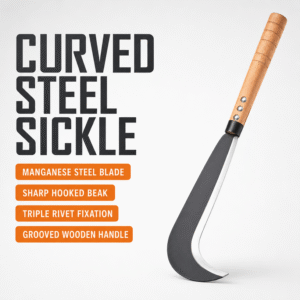
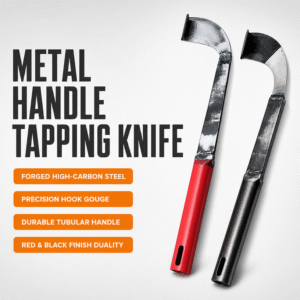
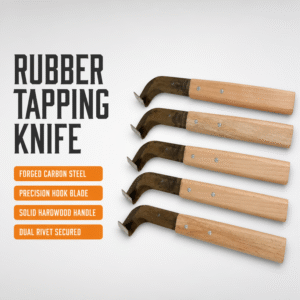
Use a dimensioned, front-on profile for the main blade and hook. Define projection from a marked reference line, opening, depth, curvature and left/right orientation.
Mark the main cutting edge separately from the hook’s inner edge. Specify whether that inner edge is sharp, blunt or partly ground when delivered.
Agree blade and overall length endpoints, including how the outermost projection is treated. Record thickness and width at the main working section too.
| Detail | What needs checking | Buyer action |
|---|---|---|
| Hook projection and opening | Reference line, depth and curve on the approved outline | Request a measured drawing and retained sample. |
| Orientation and edge | Gathering direction; inner edge sharpened, blunt or partial | Write the final delivered finish into the model code. |
| Cutting and carrying | Clearance near plants; clothing and guard contact | Trial with intended users and check exact-profile protection. |
| Production consistency | Shape across finished units and attached handles | Agree tolerances and sample multiple units. |

How Should Buyers Check Field Fit and Protection?
Compare coded finished samples with locally used plain-tip or hooked references. Prepare the main edges comparably and follow local safe-working procedures.
Ask intended users about gathering reach, control and contact with standing cane. Record differences by task; one short trial cannot prove universal speed or blade life.
Inspect the handle joint, hook finish and any wear afterward. Record hard-object impacts separately. Test guards and storage against the completed outline, not a straight-blade assumption.
Cane-knife listings show hooked and straight examples, but their photos and titles do not establish a buyer’s required hook geometry.
Request a Wholesale Quote:Whatsapp : (+86 13383021196) E-mail : gemlight@ganzhedao.com
How Do You Order the Same Hook Twice?
Keep hooked and plain-tip designs under separate model codes. Link the accepted drawing, finished sample and protective cover to each purchase order.
RFQ checklist:
- Harvest task and reference knife: explain the intended pulling/cutting sequence so a visually similar hook is not assumed to fit.
- Projection, opening, curve and orientation: define reproducible measurement points so each supplier prices the same outline.
- Main and inner-edge finish: clarify sharpening and finishing cost rather than comparing unlike delivered tools.
- Handle and finished sample: control assembly and swing feel beyond blade-only drawings.
- Guard, packing and storage: prevent an exposed projection or unsuitable straight-blade sheath in the shipment.
- Tolerances, sampling and change notice: detect reversed, reshaped or unfinished hooks in production and reorders.
Request a production-intent hooked sample and measured tip drawing before placing the bulk order.
At receipt, compare finished units and carton labels to the approved version. Record later user feedback by model and batch.

Buyer FAQ
Must the inside of a cane-knife hook be sharp?
No universal rule follows from the word “hooked.” State the approved intended use and delivered edge condition.
Is one hook-size number enough?
No. Projection needs a reference line; opening, depth, curve and direction also affect fit.
Can a straight-blade sheath protect a hooked tip?
Not by assumption. Check the exact finished profile with its guard or packed cover.
Can a brief trial prove higher harvest output?
No. It can reveal local handling problems, not a universal productivity percentage.
Request a Wholesale Quote:Whatsapp : (+86 13383021196) E-mail : gemlight@ganzhedao.com