How Does Vegetation Type Change the Choice of Machete Blade?
A farmer cuts flexible grass in one field and woody growth at its edge. Should the same machete serve both jobs?
It might, but the blade best suited to repeated light cuts may differ from a tool workers prefer for resistant stems.
Vegetation type changes the useful balance of reach, blade mass, edge, and control. Importers should define the dominant job before selecting a pattern.
Request a Wholesale Quote:Whatsapp : (+86 13383021196) E-mail : gemlight@ganzhedao.com
Distinguish Flexible Growth From Resistant Stems
Tall grass and soft weeds can bend away from a stroke. Ask whether workers need reach, a clean edge, and comfortable repeated movement.
A longer, slimmer clearing pattern can be a candidate in open ground. Its usefulness depends on the user’s technique and available swing space.
Near planted crops, reach may matter less than controlled placement. A tool that feels good on a boundary may be awkward between rows.
Vines create another problem: tangling around tools and neighboring plants. Ask how workers clear them safely rather than assuming more blade weight helps.
Firm crop stalks are different from flexible grass. A broad cane-style blade may be worth testing when repeated stalk cutting dominates the job.
Some cane knives have hooks used to move cut stalks. The hook’s value depends on how the crew handles material after cutting.
Woody regrowth resists cutting more strongly. A blade with more forward mass can be considered, but extra weight may increase repeated-use fatigue.
Ask whether the growth includes hidden wire, stones, or very thick branches. Another tool may be more appropriate for part of that work.
Avoid declaring one exact blade style from a broad label like “brush.” Describe stem size, density, and how often each type appears.
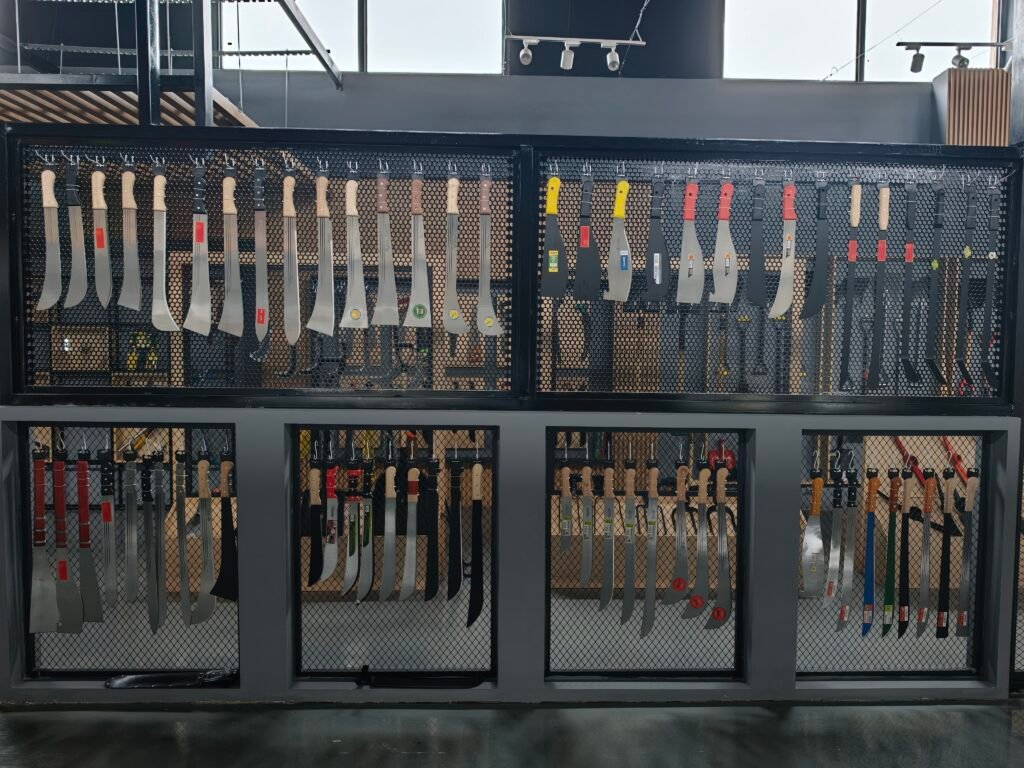
Compare Shapes Without Treating Names as Guarantees
Catalogs group bush, panga, bolo, cane, and other blades under the broad term “machete.” Profiles vary inside each group.
A bush or Latin-style candidate often has a straighter outline. It may suit some green vegetation, depending on length and finished edge.
Many bolo-style examples widen toward the front. That can change chopping feel, but it does not determine every local bolo model.
Commercial panga-style blades often show a pronounced belly or upturned tip. A local buyer may still expect a different panga profile.
A cane knife can be straight-tipped or hooked. Neither version should be ordered solely because the field grows sugarcane.
Measure blade length separately from overall length. Compare width at defined points, thickness where needed, and assembled weight.
Ask how the edge arrives. A sharp-looking sample and an unsharpened production blade are not equivalent finished goods.
Examine handle construction and grip. The best-looking profile may fail if the handle does not fit workers’ normal use.
Regional names help locate candidate tools. Approved drawings and samples define what a supplier must deliver.
Request a Wholesale Quote:Whatsapp : (+86 13383021196) E-mail : gemlight@ganzhedao.com
Run Separate Trials for Each Main Task
Choose a locally accepted reference and two or three candidate profiles. Give each model a clear identifier.
Test flexible vegetation and woody growth separately. A single mixed patch may hide why a tool feels better or worse.
Record control near crops, repeated-use comfort, and whether plants fold away from the blade rather than cutting.
Check how many times workers sharpen each sample during a comparable trial. Keep edge preparation similar before starting.
Ask whether a heavier front feels helpful on woody material but tiring on grass. Do not decide by one dramatic cut.
Observe whether a hook helps stalk handling or catches unwanted growth. That answer belongs to the actual harvest workflow.
Inspect edges and handle joints after testing. Note any hard-object impacts that may distort the comparison.
A short trial can reveal an obvious mismatch, but it cannot prove years of durability or a precise productivity gain.
If the market has mixed jobs, consider two clearly differentiated models. A compromise may be acceptable only after users test it.
Ask workers which task determines their buying decision. A crew may accept slower brush cutting to gain control near crops.
Separate seasonal growth from everyday growth. A brief period of tougher vegetation may justify a supplemental tool rather than replacing the main model.
If stems vary widely, photograph representative examples with a size reference. Suppliers need more than an unscaled close-up of one branch.
Record the limitations of each candidate. A useful sales description should say what job the tool targets, not call every model all-purpose.
Check how crews maintain the edge after cutting abrasive or dirty vegetation. Maintenance conditions can change the preferred finished blade.
Specify the Model the Vegetation Calls For
Describe the main vegetation, field conditions, intended users, and current tool in the RFQ. Avoid quoting only a crop name.
Attach photographs of both the growth and a locally accepted blade. Ask suppliers to explain any profile differences.
Write dimensions, finished weight where relevant, edge condition, handle, finish, guards, and packing for each option.
If material and hardness matter, require a declared grade and agreed test method. Avoid borrowing unsupported figures from marketing descriptions.
Make alternatives separate quote lines with distinct model codes. Do not let a supplier swap a cane knife for a bush blade without approval.
Approve a finished sample after field comparison. Tie production checks and repeat orders to that exact drawing revision.
For a tender, follow its written equivalence rules and inspection requirements. A tool preferred in an informal trial may still be noncompliant.
The right machete is the one whose full design matches the vegetation workers actually cut most of the time.
Send your vegetation photos and existing blade with an inquiry. We can discuss samples for those specific cutting conditions.
Request a Wholesale Quote:Whatsapp : (+86 13383021196) E-mail : gemlight@ganzhedao.com