What Cane Knife Features Matter for Cutting and Gathering Stalks?
A crew cuts cane at the base, then moves the stalks into rows. One buyer wants a hook on every knife. Another prefers a plain tip.
Neither preference is enough by itself. The right cane knife depends on how workers divide cutting, gathering, and carrying tasks.
For importers, the main decision is not whether a knife looks specialized. It is whether its finished blade fits the local harvesting routine.
Request a Wholesale Quote:Whatsapp : (+86 13383021196) E-mail : gemlight@ganzhedao.com
Separate the Cutting Job From the Gathering Job
Ask workers to describe a full harvest sequence. Who cuts the stalk, who removes unwanted material, and who gathers it afterward?
Some crews use the cutting tool to pull or position stalks. Others handle cut cane by hand or with another tool.
A projecting hook may help a worker move cut stalks. It should not be presented as a guarantee of faster harvesting.
Check whether the hook is intended for pulling, cutting, or both. Do not assume its inner curve arrives sharpened.
If the hook rarely gets used, its extra projection may add inconvenience near standing rows. Let intended users judge a finished sample.
A plain-tip cane knife can still cut stalks effectively. The absence of a hook does not make it a general-purpose clearing blade.
Ask whether workers cut near the soil, at another height, or in several passes. Their movement affects useful blade and handle geometry.
Also ask whether the stalks are upright, lodged, or tightly packed. One field demonstration may not represent the normal crop.
Record what workers dislike about their present tool. Complaints about edge finish and grip cannot be solved merely by adding a hook.

Inspect the Blade and Hook as Separate Features
Request a full-size profile drawing and front-on photograph. Mark blade length, overall length, widest point, and the cutting edge.
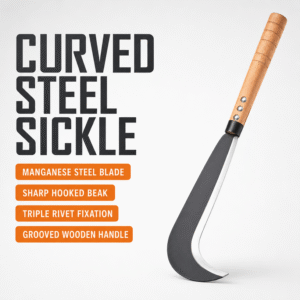
For a hooked model, specify hook projection, opening, curve, and edge treatment. Two knives both called hooked can look quite different.
Check whether a guard or sheath covers the hook as well as the main edge. A straight-tip cover may not fit.
A broad forward section can change swing feel, while thickness changes the blade’s construction. Compare completed tools, not silhouettes alone.
Measure finished weight with the handle attached. A light-looking blade may feel different after the handle or hook design changes.
Look at the blade-to-handle joint. Loose assembly can make a suitable profile unacceptable during repeated field work.
Ask what edge condition is supplied. Some cataloged cane knives have a factory grind but require sharpening before first use.
Compare quotations for the same condition. A ready-to-use edge and a tool needing local finishing are different delivered products.
If a material designation is important, require the supplier to identify it. Do not infer steel grade from the word “cane.”
Hardness requirements should include the test method and location. Do not copy a figure from another manufacturer’s unrelated knife.
Request a Wholesale Quote:Whatsapp : (+86 13383021196) E-mail : gemlight@ganzhedao.com
Trial Cutting and Gathering Without Guesswork
Let representative workers try plain-tip and hooked samples on comparable cane under established local safety procedures.
Observe whether each blade reaches the intended cut comfortably. Then ask workers how they move the cut stalks.
Record when the hook actually helps. A worker may value it for pulling one stalk but dislike it in crowded growth.
Ask about grip control during repeated strokes. A blade preferred for gathering may not be the best choice for extended cutting.
Inspect the edge and handle joint after use. Distinguish normal dulling from an assembly or finishing defect.
If the trial includes different field conditions, label them. Wet ground, lodged cane, and closely planted rows can alter feedback.
Do not convert a brief sample trial into a productivity claim. Its purpose is to reveal fit and obvious problems before buying cartons.
If crews disagree, consider two clearly differentiated models. One universal knife may be less useful than a controlled, limited range.
Ask who sharpens the knives between shifts. Workers may avoid a hooked profile if its unusual edges are difficult to maintain locally.
Check whether workers wear gloves and how they carry tools between rows. The guard and handle should fit the ordinary routine.
If cut cane is tied into bundles, ask whether the knife is involved. Gathering requirements may differ from loose-stalk handling.
Record how many samples were used and by whom. One enthusiastic tester should not decide a distributor’s entire inventory.
Test the specific hook design quoted for production. Approval of one sample does not authorize a different hook under the same product name.
Turn the Choice Into an Orderable Specification
State the selected tip type and attach the approved drawing. Give straight and hooked versions separate model codes.
Define blade length, overall length, width, thickness where required, finished weight, handle construction, edge condition, and surface finish.
Specify whether hook surfaces are sharpened. If they are not, record that too so inspectors do not guess.
Include guard or sheath fit, individual wrapping, and carton packing. These details affect both handling and landed cost.
Ask suppliers to identify any difference from the reference sample on a separate quotation line. Do not accept a silent substitution.
For a tender, follow the purchaser’s specified dimensions and approval procedure. A seemingly helpful hook may still be an unauthorized deviation.
Before bulk production, approve a finished sample bearing the same code as the purchase order and inspection sheet.
Recheck that sample against the first production units. The hook, handle, edge, and packing all belong to the finished product.
The best cane knife supports the crew’s actual cutting and gathering sequence, not a generic idea of how cane should be harvested.
Send a photo of the current knife and describe how your crews handle cut stalks. We can discuss a sample against that workflow.
Request a Wholesale Quote:Whatsapp : (+86 13383021196) E-mail : gemlight@ganzhedao.com