How Do You Machete Match Blade Length to Crop Spacing and Working Conditions?
A buyer sees two machetes labeled 18 inches. One reaches farther, while the other feels easier to control near young plants. Why?
The label may measure only the blade, and length alone cannot describe shape, handle, balance, or the space in which workers swing.
For agricultural orders, start with the crop layout and task. Then compare complete tools under real working conditions before fixing a length.
Request a Wholesale Quote:Whatsapp : (+86 13383021196) E-mail : gemlight@ganzhedao.com
Measure the Working Space, Not Just the Crop
Ask how wide the spaces between crop rows are and where workers stand during cutting. The accessible swing space is the practical constraint.
A plantation may have broad paths but narrow spaces beside plants. The same crew can need different tools on each route.
Note fences, irrigation lines, posts, and other workers nearby. Greater reach is not automatically useful when control is limited.
Ask whether the blade cuts low weeds, tall grass, stalks, or woody regrowth. Crop spacing matters together with vegetation height and resistance.
Record whether workers cut toward open space or away from valued plants. A longer arc may increase the need for careful control.
If the job is mostly open clearing, additional reach might help. If cuts occur close to crops, a shorter pattern may be easier to place.
These are options to test, not fixed row-spacing rules. A crop name alone cannot prescribe a blade length for every farm.
Ask local users which tool currently feels too short or too long. A known reference anchors the trial better than a catalog recommendation.
Consider walking, transport, and storage between plots. A long working blade may be less convenient for a mobile maintenance crew.
Distinguish Blade Length From Overall Length
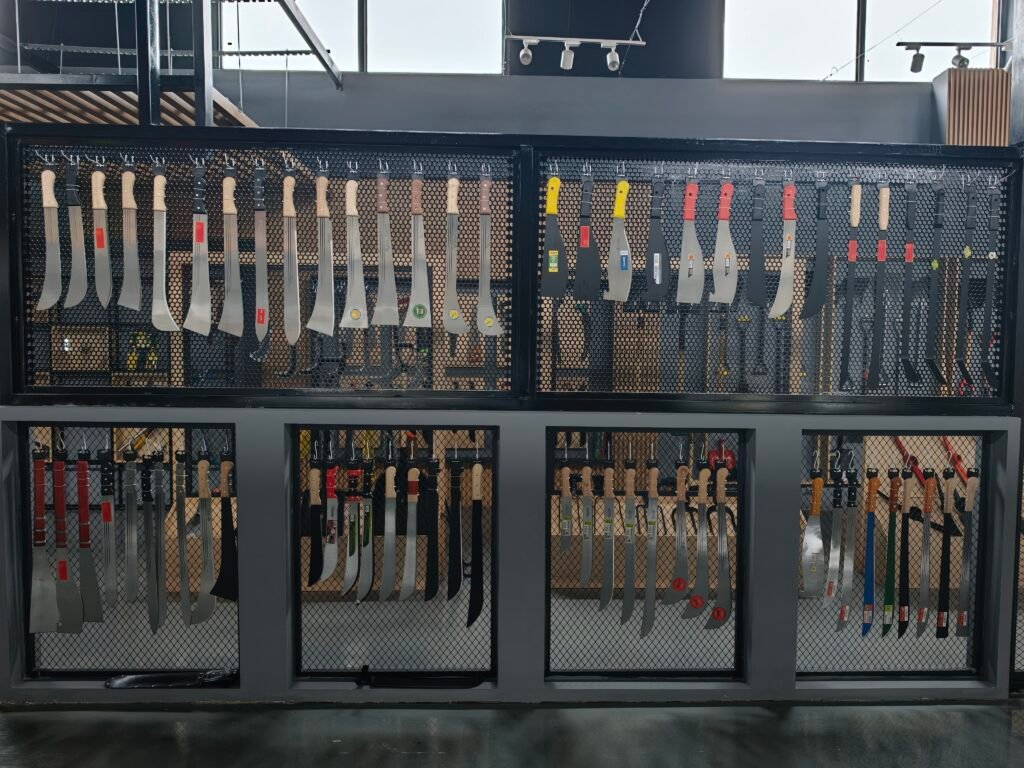
Some listings give blade length; others give the full tool length. Never compare those figures as if they were the same.
Ask where each measurement begins and ends. Include a dimensioned drawing or flat photograph with a properly placed ruler.
Record blade length, total length, handle length, blade width, and tip geometry for every candidate.
A broad front section can make one blade feel more forward-heavy than a slimmer model of the same length.
Handle length also changes the finished tool. A two-handed cane knife and a short-handled knife may use similarly sized blades differently.
Compare assembled weight, not blade blanks. Workers hold the completed tool for repeated strokes in the field.
Check how much of the blade is actually sharpened. A long unsharpened section does not add equivalent cutting reach.
If a hook extends beyond the cutting edge, record its projection separately. The longest point may not be the point used for cutting.
Avoid claims that one published length is the best for all crops. Even within a market, local working habits vary.
Request a Wholesale Quote:Whatsapp : (+86 13383021196) E-mail : gemlight@ganzhedao.com
Test Control and Fatigue in Representative Rows
Choose a familiar reference and a small set of candidates. Give each sample a distinct code so feedback stays tied to the correct size.
Have workers compare tools in open space and tighter rows where relevant. Record control near plants, not only the amount of grass cleared.
Ask whether the tip reaches the target without uncomfortable body movement. Do not assume a longer blade always reduces effort.
Observe repeated-use comfort over a realistic period. A blade that feels effective for one cut may feel tiring over many strokes.
Compare edge condition before testing. A sharper short sample and a dull longer sample cannot fairly isolate length.
Ask whether the candidate catches surrounding vegetation or strikes obstacles more often. Record the exact conditions when it happens.
If user preferences differ, look at job assignment. Some crews may benefit from separate tools for rows and boundary clearing.
Test the same worker with both lengths when possible. Differences between users can otherwise look like differences between blades.
Ask whether workers switch hands or grip positions during the day. A longer handle can change control independently of blade length.
Record which version workers voluntarily choose after repeated tasks. The answer may differ from an initial preference at the sample table.
Where rows are uneven, include the narrowest normal working area rather than testing only the widest opening.
Inspect handles and edges after the trial. Damage may relate to hidden stones or misuse rather than the selected length.
Treat results as local evidence, not a guarantee across every plantation. Repeat the assessment if terrain or crop layouts differ materially.
Specify the Chosen Tool for Bulk Ordering
Record blade and total length separately in consistent units. State acceptable tolerances and the points where measurements will be taken.
Tie dimensions to the approved blade outline, handle, finished weight, edge condition, and tip. Length alone cannot preserve the accepted feel.
If the same profile comes in multiple lengths, give each a separate code. Do not allow packing teams to substitute sizes by shared name.
Ask suppliers to confirm the finished-unit condition and protective packaging. A longer tool may require different carton or guard dimensions.
For tender orders, follow exact published dimensions and equivalent-product rules. Field preference cannot quietly override a mandatory specification.
Compare supplier quotations on the same complete configuration. A cheaper blade without final sharpening or a guard is not a direct match.
Approve a preproduction sample and measure early production units against it. Reconfirm the selected size before repeat shipments.
Review feedback after the first order. A manageable size mix may serve buyers better than forcing one length into every farm job.
The right length is the one that gives workers the needed reach while preserving control in their actual working space.
Send row-layout photos, task details, and the current tool with an inquiry. We can discuss a measured sample rather than guessing a size.
Request a Wholesale Quote:Whatsapp : (+86 13383021196) E-mail : gemlight@ganzhedao.com