When Does “Machete” Describe a Whole Category Rather Than One Blade Shape?
A buyer requests a machete and receives photographs of a bolo, a cane knife, and a straight bush blade. Which supplier understood the request?
Possibly all three. In international farm-tool sourcing, “machete” often names a broad group of long cutting blades rather than one fixed outline.
That broad meaning helps buyers find suppliers. It does not tell a factory which finished blade, handle, or edge to make.
Request a Wholesale Quote:Whatsapp : (+86 13383021196) E-mail : gemlight@ganzhedao.com
Why Does the Word Cover Multiple Patterns?
Farm cutting jobs differ by crop, vegetation, region, and worker habit. Blade profiles developed or became popular for different local uses.
Commercial catalogs group bolo, panga, cane, and bush styles within their machete sections. Those are useful examples, not an exhaustive standard.
A cane knife may also be sold as a cane machete. Its crop-specific use remains important even when the broader category overlaps.
A market may use “cutlass” for a farm blade that another seller lists among machetes. The local word alone cannot fix its shape.
Likewise, panga can refer to a local working tool while panga-style machete describes a catalog pattern. Both need an actual product reference.
Do not assert that every blade under a regional name is identical. Sales terminology is more flexible than manufacturing specifications.
The broader category is useful on a site navigation menu. A buyer can then filter toward the work and profile needed.
It is less useful as a complete purchase order line. “Machete, 1,000 pieces” leaves too many physical details unresolved.
Treat the broad word as an invitation to ask the right narrowing questions, not to guess which pattern is most common.
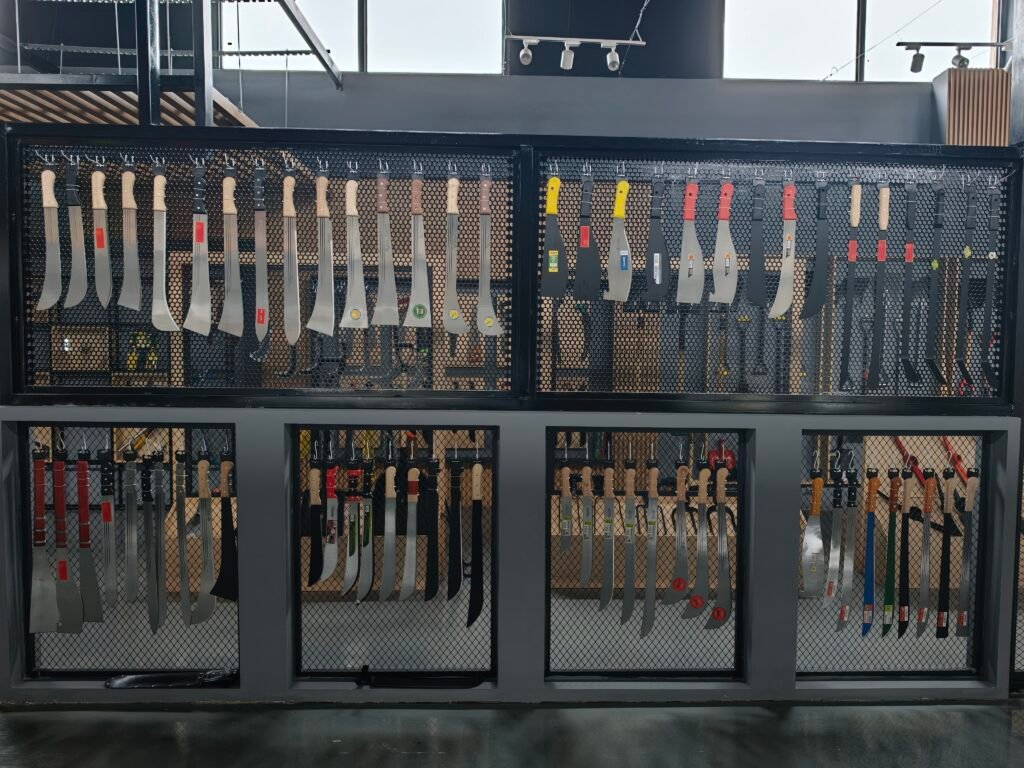
What Does a Pattern Name Add?
“Bolo-style” can suggest a broader forward section in many commercial listings. It still leaves exact width and balance open.
“Panga-style” may suggest a deeper belly or upturned tip in some catalogs. Local panga models can vary and deserve direct comparison.
“Cane knife” points toward a harvesting task. A straight tip and a projecting hook remain different orderable versions.
“Bush” or “Latin-style” often indicates an all-purpose profile in catalogs. It is not proof that every seller uses matching dimensions.
Each narrower label helps a buyer screen products. None removes the need for photographs, measurements, and a finished sample.
Two patterns can share a blade length but differ markedly in width and weight distribution. A product family name cannot resolve that.
The handle and edge also matter. A blade that looks right may arrive with different sharpening or an unfamiliar grip.
If a buyer asks only for “machete,” begin with the intended cutting job and a locally accepted tool. Then propose candidate profiles.
Ask whether workers need reach for soft vegetation, a broader cutting section for stalks, or a compact tool for confined work.
Do not settle that choice from a crop name alone. Workers may harvest, clear, and maintain the same plantation using different blades.
If a supplier has several candidate patterns, list them as separate samples with their own dimensions and finished-unit conditions.
A supplier should state when an offered pattern is an alternative, not silently call it the requested model.
Request a Wholesale Quote:Whatsapp : (+86 13383021196) E-mail : gemlight@ganzhedao.com
How Should a B2B Catalog Use the Category?
Use machetes as a broad category where customers expect that grouping. Give each physical model its own code and clear title.
A product page should show full-length blade images, overall and blade length, tip shape, handle, and the main task it targets.
Include alternative local names only when they help the intended market recognize the actual tool. Avoid listing unrelated synonyms as keywords.
For example, a specific hooked cane knife may sit under “cane machetes” while its page identifies the hook and exact model.
If one SKU carries two market-facing names, show one specification behind them. Do not create the impression of two different products.
If two products differ physically, assign two codes even if the market uses the same general word for both.
Keep the downloadable catalog, website images, quote, sample tag, and carton label aligned with the approved code.
When a supplier changes blade shape, update the revision and photographs. A category page should not conceal changes to an orderable SKU.
A useful catalog reduces search friction without encouraging a buyer to order by an imprecise name alone.
Turn a Broad Request Into a Specific Order
Ask what the workers cut: cane stalks, soft grass, mixed brush, or woody vegetation. Record the most common work, not a rare extreme.
Request a local reference photo, sample, or tender drawing. Use it to discuss which supplier models may match.
Measure blade length, total length, widths, thickness where needed, tip, edge, assembled weight, and handle features.
State finish, sharpening condition, sheath or guard, individual packing, and inspection requirements. These influence price and acceptance.
Keep separate quotation lines for each proposed pattern. A buyer should be able to reject one alternative without losing the original request.
Agree on the approved sample and drawing revision before bulk production. Tie them to one stable model code.
If a government or institutional tender specifies a pattern, follow its equivalence rules. A broad category match may be insufficient.
During delivery checks, compare finished units with the approved version rather than asking whether they all look like “machetes.”
Use the category word to open the conversation. Use a measurable model definition to close the purchase.
Send your current blade or use-case brief with an inquiry. We can discuss which defined machete pattern matches your market.
Request a Wholesale Quote:Whatsapp : (+86 13383021196) E-mail : gemlight@ganzhedao.com