What Naming Mistakes Create Wrong-Model Machete Shipments?
A buyer approves a panga sample. The cartons arrive marked “machete,” and a different blade is inside. Where did the order fail?
Often the problem started before packing. A regional name, catalog title, sample code, and purchase order pointed to different physical models.
The fix is traceability: one approved profile, one model identity, and consistent references through quotation, production, and shipment.
Mistake One: Treating Regional Names as Specifications
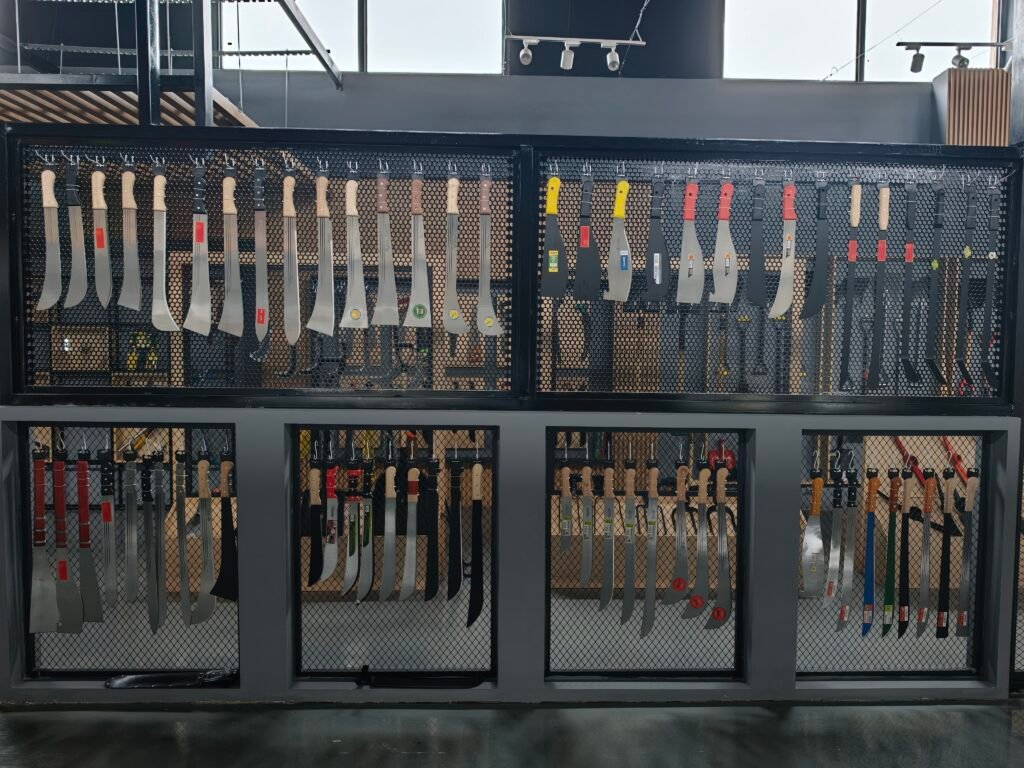
“Panga,” “cutlass,” “bolo,” and “machete” can overlap in farm-tool trade. None alone defines every blade dimension.
If a purchase order says only “cutlass,” a supplier might ship its standard clearing model instead of the buyer’s familiar local tool.
If “cane knife” lacks a tip description, a hooked and straight-tip version can be confused, even though both belong to the cane family.
Ask the buyer for a reference sample or drawing when the term is unclear. Record its intended use and destination market.
Write the local term for recognition, followed by an exact model code and measurable description. Do not delete the term; qualify it.
Some differences are small in photographs but obvious to workers. Tip curvature, blade belly, and grip can decide local acceptance.
A tender may have its own definition. The supplier’s familiar catalog labels do not replace the tender drawing or approval rules.
Avoid translating a regional word into the nearest English word without checking the actual tool. Translation alone can move an order to the wrong SKU.
A sales person should pause when a customer asks, “Do you mean our panga or their cutlass?” That is a request for clarification.
Request a Wholesale Quote:Whatsapp : (+86 13383021196) E-mail : gemlight@ganzhedao.com
Mistake Two: Reusing One Code for Different Blades
A factory may group several blade profiles under a broad stock name. That can work internally until a buyer orders by the shared code.
If straight and hooked cane knives share one SKU, the warehouse cannot know which profile the purchaser approved.
Assign separate model codes to distinct outlines, handle configurations, and edge conditions when those differences affect the order.
Include a revision when a mold, tooling, tip, or handle changes. Do not silently replace a previously approved version.
The code should appear on the product sheet, sample tag, quote, purchase order, packing list, and inspection record.
If two markets use different names for the same physical model, keep the technical code stable. Map each market-facing name to that code.
Do not let packaging artwork become the only identifier. A carton marked “machete” can contain several legitimate but different products.
Check whether barcodes and retailer item numbers refer to the current revision. Old labels may remain after a product redesign.
A replacement order should point to the approved sample, not merely to an old sales nickname remembered by staff.
Mistake Three: Letting Photos and Quotes Disagree
An attractive catalog image may show one profile while the price covers another. Buyers often discover that difference only at sample review.
Show the actual finished tool in full-length and tip close-ups. Include the handle attachment and a scale reference.
Identify the photograph with the quoted model code. Avoid one shared hero image for physically different sizes or profiles.
Record blade length and overall length separately. The phrase “18-inch machete” can conceal different measurement conventions.
Mark blade widths and tip outline on a drawing. An angled photo can distort the forward belly of a bolo or panga.
State the condition of the edge and whether a sheath or guard is included. Finished-tool differences can become shipment disputes.
Ask suppliers to list deviations from the buyer’s reference. An alternative should have its own code and quote line.
Where the sample differs from the PDF image, correct the document before approval. Do not assume inspectors will know which one prevails.
If a field test changes the selected model, update all documents immediately. A verbal choice cannot guide a distant packing team.
Request a Wholesale Quote:Whatsapp : (+86 13383021196) E-mail : gemlight@ganzhedao.com
Mistake Four: Weak Sample and Document Control
A sample without a dated code can be separated from its quotation. Months later, nobody knows which blade the customer accepted.
Tag each approved sample with model and revision. Save dated photographs and a dimensioned drawing under the same identifier.
Obtain written approval for substitutions before production. “Similar machete” is not enough when local workers expect a particular shape.
Confirm that production instructions match the accepted sample. Check the first finished units for profile, grip, edge, and packing.
Use an inspection checklist tied to measurable points, not to a judgment that the shipment generally looks correct.
If a tender requires specified tests or documentation, include them in the order file. Do not claim compliance without corresponding evidence.
Before cartons are sealed, reconcile packed SKU, carton marks, packing list, and buyer order. Mixed models should be separated clearly.
If a discrepancy appears, stop and resolve it before dispatch. A wrong-model shipment costs more to correct across borders.
For reorders, reconfirm the approved reference. Suppliers may change tools, material sources, or handle details without changing the market name.
A Simple Handoff That Prevents Wrong Models
Start every inquiry with the local name, intended use, reference image, and target market. Request the supplier’s exact product code.
Compare sample and drawing, then fix blade profile, dimensions, handle, edge condition, finish, and packing in the purchase order.
Use the same code and revision throughout production, inspection, and shipment documents. Ask for any deviation to be approved in writing.
The point is not to ban flexible local names. It is to prevent a flexible name from becoming the only instruction the factory receives.
Send your accepted blade sample or drawing with an inquiry. We can discuss a quote tied to a specific, checkable model.
Request a Wholesale Quote:Whatsapp : (+86 13383021196) E-mail : gemlight@ganzhedao.com