Quick Answer
A straight-back machete is defined partly by a straight section of the spine, not by its entire cutting profile. Specify where that straight section starts and ends, plus blade and overall lengths, width stations, tip, working edge and handle. Compare a finished sample with the local tool, then attach the accepted drawing and model code to every quote and inspection.
Key Takeaways
- A straight spine does not require a straight cutting edge.
- Two straight-back designs can differ in width, tip and usable edge length.
- A product title cannot replace an approved dimensioned profile.
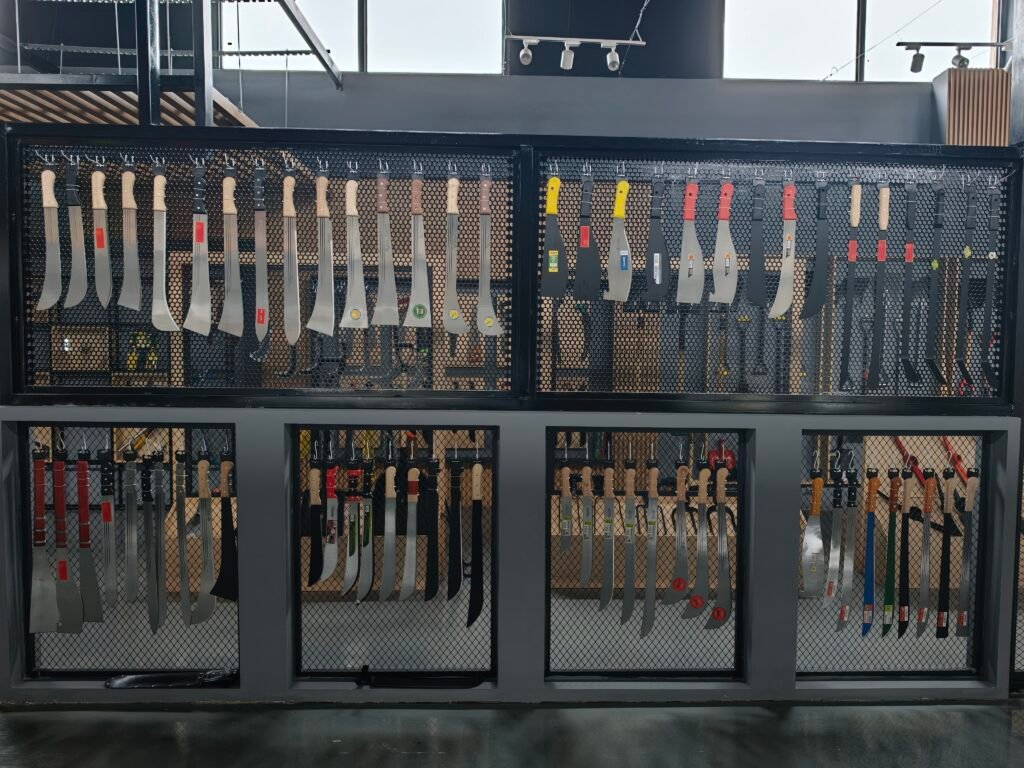
What Does “Straight-Back” Mean on This Model?
The back normally means the spine opposite the main cutting edge. Mark exactly which part should be straight and where any change near the tip begins.
The edge can curve even when the spine is straight. A secondary sharpened back edge should never be assumed; mark it if the approved design requires one.
Local names may help customers recognize a bush or Latin-style blade. They cannot identify one unique outline. The machete-style guide groups straight-backed bush patterns without fixing one wholesale specification.
Request a Wholesale Quote:Whatsapp : (+86 13383021196) E-mail : gemlight@ganzhedao.com
Which Dimensions Belong on the Approved Drawing?
Show blade and overall lengths on the finished tool with marked endpoints. Measure width at multiple positions, not only at the broadest point.
Record the straight spine segment, edge curve, tip and sharpened start/end on a flat profile. Include stock thickness at a stated location.
Add grip dimensions, handle material and attachment, finished weight where handling matters, and the delivered sharpening and surface condition. Agree on practical tolerances and revision control.
| Feature | Needs verification | Buyer action |
|---|---|---|
| Spine and tip | Straight segment, tip transition and any secondary edge | Mark a baseline on the dimensioned drawing. |
| Blade and working edge | Blade/overall endpoints, width stations and sharpened limits | Check finished samples against the same stations. |
| Construction | Thickness, handle, edge finish and assembled weight | Price the complete tool, not a blade sketch. |
| Order control | Sample code, revision, guard and carton label | Link production units to the accepted version. |
How Can Buyers Confirm It Fits the Farm?
Compare the finished model with a locally accepted blade on ordinary grass, mixed brush or vegetation beside crops as relevant. Keep edge preparation comparable.
Record reach, control and comfort over repeated work. Note whether a changed tip, handle or length affects the guard, carrying or sharpening practice.
Where crews prefer different lengths or outlines, give each an independent drawing and model code. A worn reference blade may no longer show the original profile.
Product examples on a bush/Latin-style category page show that the style label includes materially different finished tools.
Request a Wholesale Quote:Whatsapp : (+86 13383021196) E-mail : gemlight@ganzhedao.com
How Should the RFQ Preserve the Pattern?
Send all bidders one controlled drawing and reference-sample code. Require alternatives or deviations to be labeled and approved separately.
RFQ checklist:
- Straight-spine segment and tip transition: keep the quoted profile unambiguous.
- Blade/overall length and width stations: prevent a broad alternative from passing as the same model.
- Edge endpoints, thickness and finish: compare delivered working blades, not unlike blanks.
- Handle material, size and assembly: preserve the locally accepted finished feel.
- Guard, carton label and packing: check accessory fit and avoid mixed variants.
- Sample revision, tolerances and change notice: inspect early production and prevent silent substitutions.
Request a production-intent finished sample before comparing bulk quotations.

Buyer FAQ
Does straight-back mean a straight cutting edge?
No. Specify the edge separately on the controlled profile.
Does a bush/Latin-style name fix the width?
No. Named products have different outlines; mark width stations and retain a sample.
Can a blade-only drawing approve the whole tool?
No. Review handle, sharpening, weight and accessory fit on the finished assembly.
Must a changed tip be approved?
Yes if it departs from the approved drawing or affects use or guard fit.
Request a Wholesale Quote:Whatsapp : (+86 13383021196) E-mail : gemlight@ganzhedao.com