Quick Answer
Compare manual harvesting blades by the crop, the sequence of cuts, and the space workers have before comparing product names. Document each finished blade’s profile, handle, edge, and packing; then trial coded samples against an accepted local tool. Select only models that meet mandatory requirements and can be reproduced, priced, and inspected in their delivered condition.
Key Takeaways
- Names such as cane knife, bolo, cutlass, and machete do not fix a blade’s exact dimensions or finished configuration.
- A preferred trial sample cannot replace a mandatory tender requirement.
- A short field trial cannot establish years of durability or a market-wide productivity gain.
- Request a Wholesale Quote:Whatsapp : (+86 13383021196) E-mail : gemlight@ganzhedao.com
Define the Crop and Cutting Sequence
Begin with the work, not a catalog category. Does the crew cut thick stalks, flexible stems, surrounding vegetation, or several materials in one shift? Identify where each cut happens and whether workers gather, trim, or strip material afterward.
Record row spacing, nearby plants, and the frequency of manual cutting. A tool used for a full shift needs more careful handling and comfort evaluation than an occasional backup.
Photograph and measure the locally accepted tool, including its outline, handle, edge, and tip. Note if repeated sharpening has shortened or changed the reference blade; do not ask a factory to copy wear as if it were an original design.
Keep local terms such as “cutlass,” “cane knife,” and “machete” in the inquiry, but define the required geometry separately. A cane-knife offer may have a plain or hooked tip; ask how the crew handles cut material before approving either design.
Separate mandatory tender dimensions and evidence from worker preferences. A sample that feels good but fails a required dimension is not a compliant substitute.
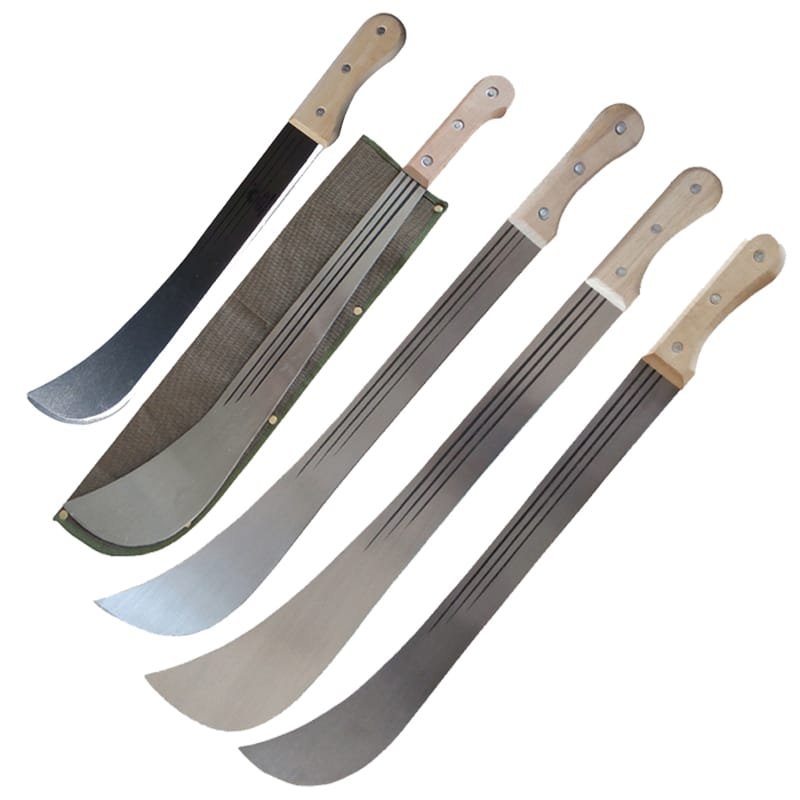
Compare Finished Tool Features on One Sheet
Request the same fields for every offer: blade and overall length, width at agreed points, specified thickness, tip shape, assembled weight, handle construction, and delivered edge condition. A nominal length cannot show how much cutting edge a profile provides.
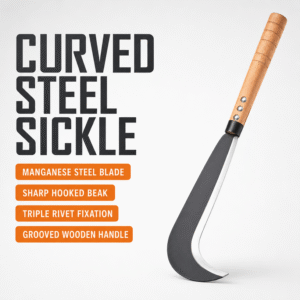
Attach a dimensioned outline for each proposed pattern. For a hooked design, define the hook projection, whether its inside curve is sharpened, and how the guard covers the finished shape. For a forward-weighted option, assess control as well as cutting feel.
Record grip length, attachment, material, and finish on the assembled tool. Ask whether a “factory-ground” blade arrives ready for the agreed trial or requires preparation. Request a material declaration where relevant; do not infer a steel grade or hardness from the product name.
| Comparison point | Evidence to verify | Buyer action |
|---|---|---|
| Crop task and cutting sequence | Crop, cutting position, row space, and any gathering or stripping step | Mark the primary task and any distinct secondary task. |
| Blade profile and tip | Dimensioned outline, measurement points, and hook details if applicable | Compare proposed designs with the local reference; flag mandatory dimensions. |
| Assembled handle and edge | Handle attachment, grip finish, delivered edge state, and sample code | Test finished samples with comparable preparation. |
| Delivered configuration | Guard, wrapping, carton quantity, labels, and optional finishing | Request itemized quotes for the same specification. |
Mark each requirement as mandatory, negotiable, or subject to sample approval. This keeps cost and performance comparisons from hiding a noncompliant feature.

Run a Fair Local Sample Trial
Choose a small set of finished samples and one accepted local control. Give every candidate a unique code that stays with its observations, drawing, and supplier offer.
Use representative crop conditions and trained workers following local safety procedures. Record edge condition at the start, and prepare samples consistently; a freshly sharpened blade should not win simply because another arrived unfinished.
Ask workers about cut placement, reach, grip, comfort, and handling after the cut. Note the task beside each response, and observe when a worker switches tools between cutting and gathering.
Where practical, include more than one user and working period. Record one- or two-handed use only for the exact sample tested. Inspect the handle joint, edge, and any hook afterward, while logging impacts with wire or stone separately.
Keep task fit, handling, sample condition, and ordering cost as separate fields rather than compressing them into one score. A preferred sample still fails if it cannot meet a mandatory tender requirement.
Ask whether the selected tool fits local sharpening and storage practices. If the prototype needs further finishing, connect every trial comment to the delivered state promised in the quote.
Compare Quotes and Approve an Inspectable Model
Ask suppliers to quote the same finished specification. Give each accepted pattern a unique model code and retain a documented drawing and finished sample. Use them to check production units, not just to choose a prototype.
RFQ checklist:
- Crop, cutting sequence, and required tender evidence: state the actual job and non-negotiable bid conditions so unsuitable offers can be screened first.
- Model code and dimensioned profile: agree on units, measurement points, and tolerances so catalog names or inch/mm listings cannot conceal different shapes.
- Completed handle and delivered edge: define grip, attachment, finish, and sharpening state so the quoted unit matches the trialed tool.
- Hook, tip, and protective guard where applicable: define sharpened areas and coverage so the complete pattern can be produced and packed consistently.
- Declared material and approved sample: request only relevant documented material properties and a retained finished reference so inspection does not rely on unsupported claims.
- Itemized options and packing: separate sharpening, guards, artwork, wrapping, carton quantity, and labels so landed costs remain comparable.
- Production inspection and deviations: agree how early and bulk units will be checked, and require disclosure of substitutions before delivery.
Request comparable finished samples against the same RFQ before committing to volume.
If separate crops or harvest stages favor different blades, use distinct, controlled SKUs rather than calling one model universal. Track complaints and repeat orders by SKU after the first shipment.
Buyer FAQ
Are a cane knife and a general machete interchangeable in a tender?
Do not assume so. Match the tender’s required geometry and evidence, then check the actual crop task and finished sample. Similar names do not establish equivalence.
Does every cane knife need a hook?
No fixed name should decide that feature. Specify the proposed tip and whether the crew needs to move cut material; approve the exact design against the task.
Can a short trial prove that one blade is more productive?
It can reveal handling preferences and obvious fit problems under observed conditions. It cannot support a broad percentage claim or guarantee long-term durability.
What if workers like a sample that fails a tender dimension?
Record their preference, but do not submit it as a compliant equivalent. Seek a design that satisfies the mandatory requirement and can be trialed in its finished form.
Request a Wholesale Quote:Whatsapp : (+86 13383021196) E-mail : gemlight@ganzhedao.com