Quick Answer
To document model equivalence for a machete tender, compile a structured technical dossier comparing the proposed tool against the named benchmark brand. Include superimposed CAD drawings, accredited chemical metallurgy reports, Rockwell C hardness tests across multiple blade zones, handle pull-off test results, and verified agricultural field trial data. Present these findings within a line-by-line tender compliance matrix.
Key Takeaways
- Equivalence documentation requires certified laboratory test reports, not generic supplier marketing claims.
- Superimpose CAD outlines and measure three width stations to prove identical cutting momentum and balance.
- Validate steel grade, 48–52 HRC hardness, bend-and-recovery performance, and field cutting durability.
Establish the Reference Benchmark Baseline
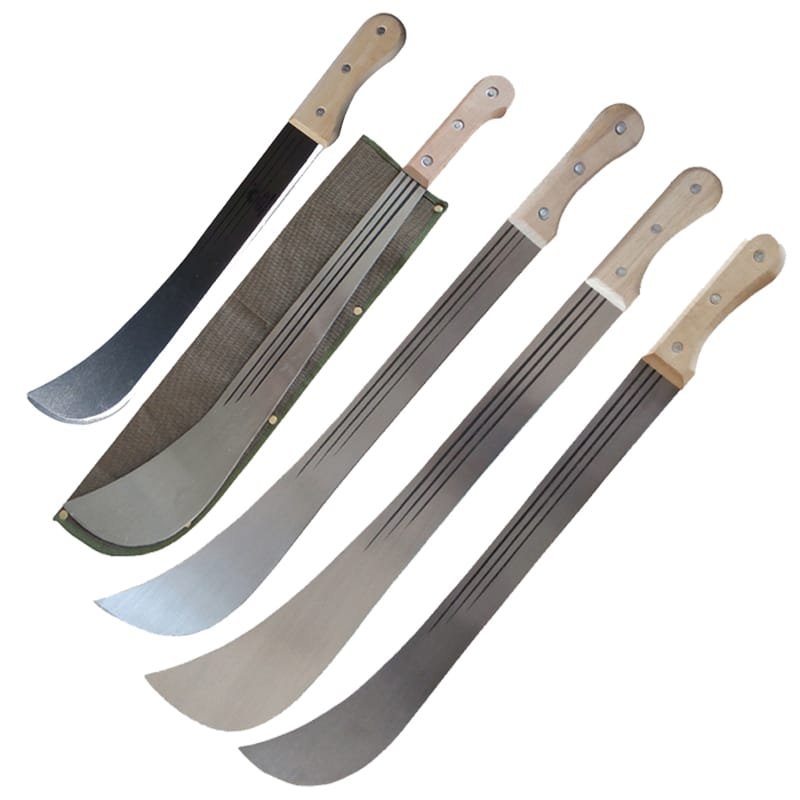
When a tender specification names a specific international brand model or states “or approved equivalent,” bidders proposing alternative models must build a rigorous technical dossier. Obtain the benchmark model’s published technical data sheet, recording blade length, spine thickness, width at three stations, belly curvature, total weight, steel chemistry, and handle construction.
Distinguish between essential functional characteristics (cutting reach, balance, blade hardness, handle fastening strength) and proprietary cosmetic styling (brand stamps or handle color). This baseline forms the benchmark against which the equivalent model is objectively measured.
Request a Wholesale Quote:Whatsapp : (+86 13383021196) E-mail : gemlight@ganzhedao.com
| Evaluation parameter | Benchmark equivalence requirement | Supporting verification evidence |
|---|---|---|
| Blade geometry & profile | Matches length, width stations, curvature, spine gauge | Superimposed CAD drawings, caliper data sheet. |
| Material chemistry | High-carbon steel (AISI 1065 / 65Mn equivalent) | ISO/IEC 17025 accredited chemical assay report. |
| Hardness & heat treatment | Uniform 48–52 HRC along cutting edge | ASTM E18 / ISO 6508 certified hardness report. |
| Handle mechanical strength | Pull-off resistance, rivet shear strength, no loosening | Standardized mechanical tensile pull test report. |
| Field performance | Cutting efficiency, edge retention, user fatigue | Structured farm field evaluation trial report. |
Provide Dimensional and Geometric Comparison Data
Create a side-by-side comparison table matching benchmark parameters against the proposed tool. Superimpose CAD engineering drawings of both blades to demonstrate profile alignment, spine straightness, and cutting edge curvature. Show that blade length, forward width, and spine thickness match the benchmark within standard procurement tolerances.
Demonstrate that handle length, grip contours, tang depth, and rivet fastening provide equivalent mechanical strength and ergonomic comfort during extended farm work. Include high-resolution photographs comparing both tools side by side beside calibrated measurement scales.
Submit Certified Material and Field Trial Evidence
Provide chemical composition and mechanical test certificates from an accredited ISO/IEC 17025 laboratory confirming steel grade equivalence (such as high-carbon 65Mn or AISI 1070). Submit Rockwell C hardness reports demonstrating uniform 48–52 HRC along the cutting edge under ASTM E18 or ISO 6508 standards, along with certified bend-and-recovery test data.
Include structured field trial data showing cutting efficiency, edge retention, and handle stability under realistic farm conditions. Summarize the technical dossier into a compliance matrix cross-referencing every tender specification clause, and submit physical production-intent samples to complete the equivalence submission.
Request a Wholesale Quote:Whatsapp : (+86 13383021196) E-mail : gemlight@ganzhedao.com
Model-Equivalence Dossier Checklist
- Named benchmark baseline data sheet: define technical reference parameters.
- Dimensioned CAD drawings and profile overlay: prove geometric alignment.
- Accredited ISO/IEC 17025 steel chemistry report: verify steel grade equivalence.
- Rockwell C hardness test reports (48–52 HRC): prove uniform heat treatment.
- Mechanical handle pull-off and bend test data: verify structural durability.
- Comparative field trial report and physical samples: validate real-world cutting performance.
Buyer FAQ
What is the difference between functional equivalence and visual similarity?
Visual similarity is cosmetic; functional equivalence requires matching steel metallurgy, hardness, cutting balance, and mechanical strength.
Can a prototype sample prove mass-production equivalence?
No. Evaluation committees require production-intent samples manufactured on standard factory tooling.
Why must laboratory test reports come from ISO/IEC 17025 accredited labs?
Accredited laboratory reports provide legally recognized, calibrated test data that withstands formal tender audits.
Request a Wholesale Quote:Whatsapp : (+86 13383021196) E-mail : gemlight@ganzhedao.com