Premium Sickle Blade – Factory Direct Pricing & Superior Quality
The sickle blade has been a fundamental tool in agriculture for millennia, enabling efficient harvesting and shaping human civilization. Let’s delve into its journey from ancient fields to modern applications.

Origins and Early Use
The sickle’s story begins in the Neolithic era, marking humanity’s shift from foraging to farming. Early sickles, often crafted from flint or bone, were designed to harvest wild cereals, laying the groundwork for settled agricultural communities. These tools featured curved blades, ideal for slicing through plant stalks with ease.
The Egyptian Sickle Blade
In ancient Egypt, the sickle blade became a symbol of agricultural prowess. Crafted from flint, these blades were integral to harvesting grains along the Nile’s fertile banks. The design usually had a wooden handle. It featured sharp flint teeth along its curve.
This shows early innovation in tool-making. These sickles not only boosted farming efficiency but also held cultural significance, often depicted in art and associated with deities linked to fertility and harvest.
Evolution and Global Spread
As metallurgy advanced, sickles transitioned from stone to metal blades, enhancing durability and cutting efficiency. This evolution spread across continents, with variations emerging to suit local agricultural needs. In medieval Europe, for instance, the sickle was indispensable for reaping crops like wheat and barley, its design refined over centuries to improve functionality and reduce strain on the user.
The Sickle Blade Knife
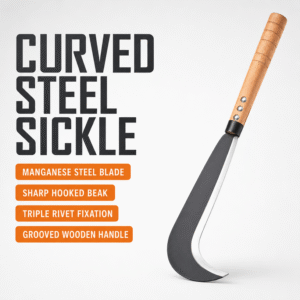
In contemporary times, the sickle’s design has influenced the creation of the sickle blade knife. This modern adaptation combines the traditional curved blade with enhanced materials, offering versatility for tasks ranging from gardening to survival situations. Its compact size and sharp edge make it a favored tool among outdoor enthusiasts and professionals alike.
Cultural Significance
Beyond its practical applications, the sickle blade has permeated cultural and symbolic realms. Notably, the hammer and sickle emblem emerged as a representation of industrial and agricultural workers’ unity, symbolizing collective labor and societal progress. This iconography underscores the sickle’s enduring association with sustenance and communal effort.
Modern-Day Relevance
Despite technological advancements in agriculture, the sickle remains relevant in various parts of the world. Small-scale farmers and gardeners continue to rely on its efficiency for harvesting crops, clearing land, and managing vegetation. Its simplicity, affordability, and effectiveness ensure its place in the toolkit of many agricultural practitioners.
Conclusion
From the ancient Egyptian sickle blade to the modern sickle blade knife, this tool’s evolution mirrors humanity’s agricultural journey. Its enduring presence across cultures and eras highlights its significance not just as an implement, but as a symbol of human ingenuity and the timeless relationship between people and the land they cultivate.
how to sharpen a sickle blade?
Maintaining a sharp sickle blade is essential for efficient cutting and prolonging the tool’s lifespan. Here’s a straightforward guide to sharpening your sickle:
Tools You’ll Need:
- Sharpening Stone: A scythe stone or whetstone works well.
- Protective Gear: Gloves and safety glasses to ensure safety during sharpening.
Sharpening Steps:
- Secure the Sickle: Place the sickle on a stable surface or hold it firmly, ensuring the blade’s edge faces away from you.
- Choose the Right Angle: Maintain the original bevel angle of the blade, typically between 20 to 30 degrees.
- Sharpening Motion: Using the sharpening stone, stroke along the blade’s edge in a consistent motion, moving from the base to the tip. Apply even pressure throughout.
- Consistent Strokes: Repeat the sharpening strokes, ensuring uniformity across the entire edge.
- Test the Sharpness: After several passes, carefully test the blade’s sharpness on a piece of vegetation or similar material.
Hone the Edge: For a finer edge, use a honing stone or a finer grit to polish the blade, enhancing its cutting efficiency.