Quick Answer
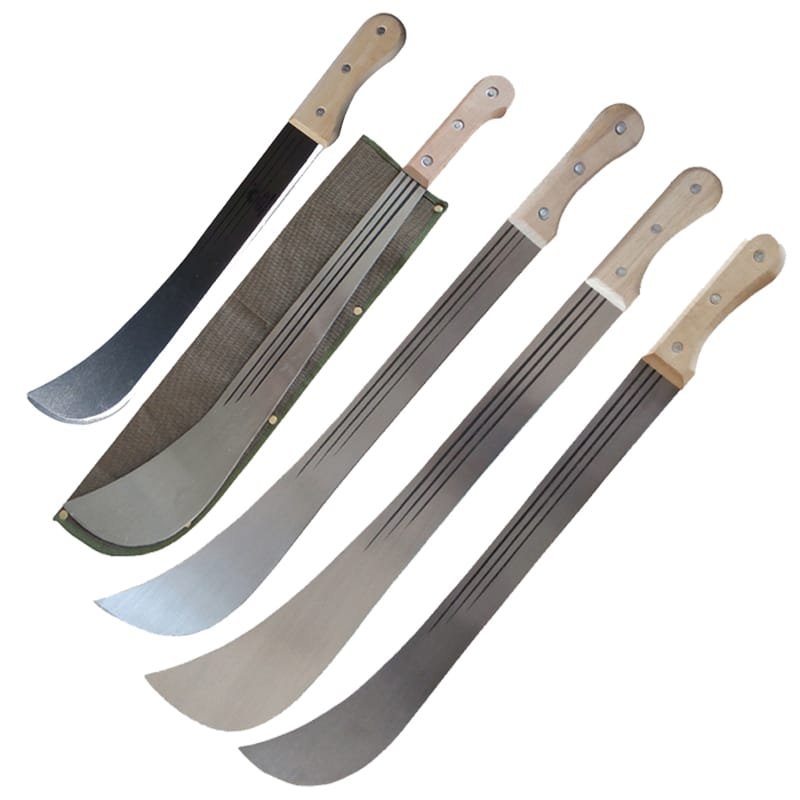
A panga’s blade profile affects balance by changing where material sits relative to the grip. Width toward the front, thickness, tip and handle construction all contribute to how a finished tool swings and redirects. Compare matched-edge, assembled samples on the intended local tasks; nominal blade length and total weight alone cannot establish the preferred feel.
Key Takeaways
- Equal total weights do not show how mass is distributed along a tool.
- The handle can change assembled handling without changing the blade profile.
- A brief local trial cannot establish universal cutting productivity.
Why Can Equal-Weight Pangas Feel Different?
A broader belly toward the front may put more material farther from the user’s hand. Thickness, taper, cutouts and tip outline also affect the distribution.
The grip matters too. A different handle length, material or attachment can change the assembled feel even when two steel blanks match.
Forward-weighted handling may help some workers on thicker vegetation and hinder repeated controlled cuts. It does not by itself prove better output or durability.
Request a Wholesale Quote:Whatsapp : (+86 13383021196) E-mail : gemlight@ganzhedao.com
Which Measurements Preserve the Panga’s Profile?
Photograph each finished blade flat against a scale. Record blade and overall length, width at agreed stations, maximum width and where it occurs.
Trace the spine, belly and upturned tip on a dimensioned outline. Check thickness and taper at marked positions, then document the actual handle and assembled weight.
If a buyer needs a numerical balance measure, define the method and reference point together with the supplier. Do not invent a universal center-of-mass requirement.
| Recorded feature | What remains uncertain | Buyer action |
|---|---|---|
| Belly, tip and width stations | How material is distributed along the blade | Retain a dimensioned silhouette and completed sample. |
| Thickness, taper and assembled weight | Weight distribution and swing feel | Measure at marked points; compare finished tools. |
| Handle material and grip length | Worker grip position and control | Hold handle design constant during sample trials. |
| Field responses | Fit for different tasks and users | Record task, user and edge preparation by sample code. |
How Should Buyers Test Handling in the Field?
Have representative workers compare coded finished tools against a local reference on similar growth, with comparable edge preparation and local safety procedures.
Observe grip changes, control near crops and comfort over repeated use. Ask about heavier cutting and lighter clearing if the buyer serves both tasks.
Inspect joints and edges after testing. A loose handle or newly sharpened candidate can distort an opinion about the profile itself.
Catalogs may group panga patterns with other machete styles; the name alone does not establish one balance for every region or user.
Request a Wholesale Quote:Whatsapp : (+86 13383021196) E-mail : gemlight@ganzhedao.com
How Can a Buyer Preserve an Accepted Balance?
Bind the accepted outline, handle, stock declaration and finished-sample reference to one model code. Keep alternatives with different bellies or tips under separate SKUs.
RFQ checklist:
- Model code and intended work: distinguish a clearing version from a heavier-cutting alternative.
- Dimensioned profile and stations: keep the belly, widest point and tip from drifting between batches.
- Thickness, material and finished weight: detect construction changes not visible in headline blade length.
- Handle specification and assembly: control grip position and joint quality that affect perceived balance.
- Edge condition and trial reference: compare equivalent finished tools rather than mistaking sharpening for better geometry.
- Sample, tolerances and change notice: check first production units and reapprove material or handle changes.
Request a finished production-intent panga for the stated task before confirming bulk supply.
Track repeat requests and complaints by model, task and batch. Feedback from one district cannot prove universal preference.

Buyer FAQ
Does a wider front always mean stronger chopping?
No. Width, thickness, edge condition and user technique interact; compare assembled samples on the job.
Is total weight enough to compare balance?
No. It does not show where the material sits relative to the grip.
Should an RFQ require a balance-point figure?
Only when both sides define a repeatable measurement method and reference point.
Can one field trial establish a market-wide winner?
No. It records local acceptance under the tested conditions, not every crop or district.
Request a Wholesale Quote:Whatsapp : (+86 13383021196) E-mail : gemlight@ganzhedao.com