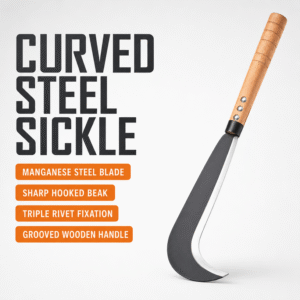
In Africa’s diverse agricultural landscapes, where farmers face unpredictable weather and uneven terrain, African farming machetes are more than just tools—they are lifelines. Engineered to endure extreme heat, heavy rainfall, and rocky soil, these blades are indispensable for tasks ranging from clearing dense brush to harvesting staple crops like cassava, maize, and yams. Their design reflects a deep understanding of local needs, making them essential for smallholders who rely on manual labor to sustain their livelihoods.
Why They Stand Out
1. Durability:
Crafted from rust-resistant stainless steel or high-carbon alloys, these machetes resist corrosion even in humid climates. Reinforced edges stay sharp through repeated use, whether cutting hardwood for fencing or slicing through thick crop stems. A single blade can last years with minimal maintenance, reducing long-term costs.
2. Versatility:
One machete replaces a toolbox. Farmers use it to clear land, trim fences, prune fruit trees, and even process firewood. In regions like East Africa, where mixed farming is common, this adaptability saves time and labor—critical for households managing multiple crops and livestock.
3. Affordability:
Locally produced models prioritize cost-efficiency without sacrificing quality. Simplified designs and accessible materials keep prices low, while some brands offer replaceable blades to extend tool life. For a Nigerian farmer earning 2–3 daily, a 10–15 machete is an investment that pays dividends quickly.
4. Ergonomics:
Lightweight handles with non-slip grips reduce hand fatigue during 8–10-hour workdays. Balanced weight distribution ensures precise control, lowering the risk of accidents—a vital feature in communities where medical care may be hours away.
Real-World Impact
In Oyo State, Nigeria, farmer Aisha Usman switched from a traditional machete to a modern African farming machete with a reinforced blade. Clearing half a hectare of land now takes her 3 hours instead of 6, freeing time for weeding and planting. “This tool isn’t just faster—it’s safer,” she says. “My hands don’t ache like before, and I can harvest more yams in a day.” Her story echoes across the continent, where efficiency gains directly correlate with higher yields and income.
Conclusion
For Africa’s 33 million smallholder farmers, African farming machetes are catalysts for resilience. By merging rugged durability, multi-functional design, and economic accessibility, these tools empower communities to adapt to climate challenges, improve food security, and build sustainable livelihoods.
Looking for a reliable machete? Choose a model engineered for Africa’s demands—where every swing counts.